

- Decomposition against moulds and mites
- Suppression against moulds
- Suppression against allergic effects of mites
Demonstration of the decomposition against moulds and mites(carcasses)
Testing organization
Joint research with Wakayama Medical University
Test method
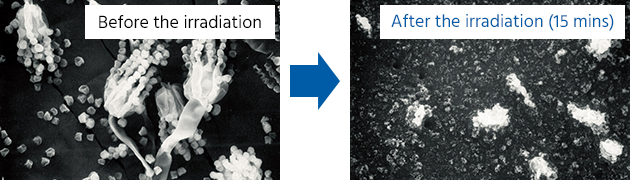
"Mould" and "mite (carcass)" were placed on the electrodes of the Streamer discharge unit, and after being exposed to the Streamer discharge for 15 minutes, they were photographed with an electron microscope.
Moulds
Mites (carcasses)
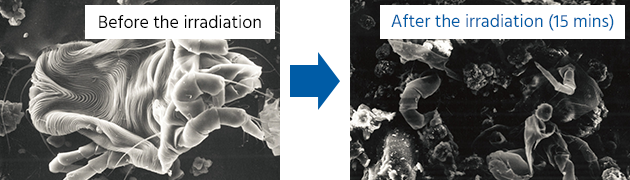
* The results are obtained from demonstration of solely the Daikin streamer discharge device in experimental condition.
Demonstration of the suppression against moulds
Testing organization
Japan Food Research Laboratories
Test method
A test piece in which the bacterial solution was cultured was placed in a container, the test Streamer generator was operated, and the viable cell count was measured after 24 hours.

As a result of the experiment, it was confirmed that 99.9% of moulds was suppressed in 24 hours by the Streamer irradiation.
* The results are obtained from demonstration of solely the Daikin Streamer discharge device in an experimental condition.
Demonstration of the suppression against allergic effects of mites (faeces and carcasses)
Testing organization
Wakayama Medical University
Test method
Allergen analysis was confirmed by ELISA method using a test Streamer generator.

As a result of the experiment, it was confirmed that 99.6% of allergic effects of mites (faeces and carcasses) was suppressed in 24 hours by the Streamer irradiation.
* The results are obtained from demonstration of solely the Daikin Streamer discharge device in an experimental condition.
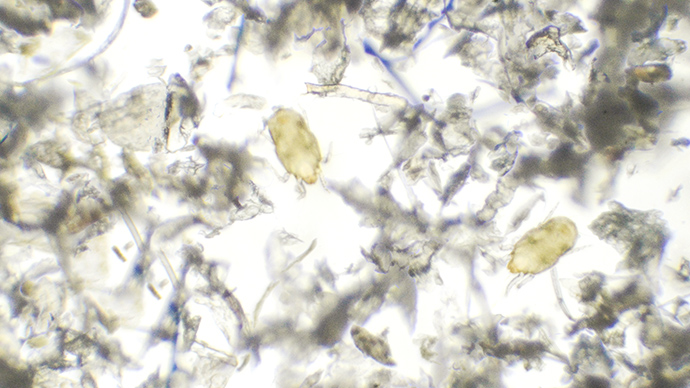
Relationship between moulds, mites and allergies
Since both moulds and mites prefer a moist environment, they breed when the humidity is high. Moreover, because the mites in the room are fed by moulds, mites are more likely to occur in places where moulds breed. When these moulds and the faeces/carcasses of mites touch human's skin or be inhaled, they cause various allergic symptoms such as atopic dermatitis, asthma, rhinitis and itchy eyes.